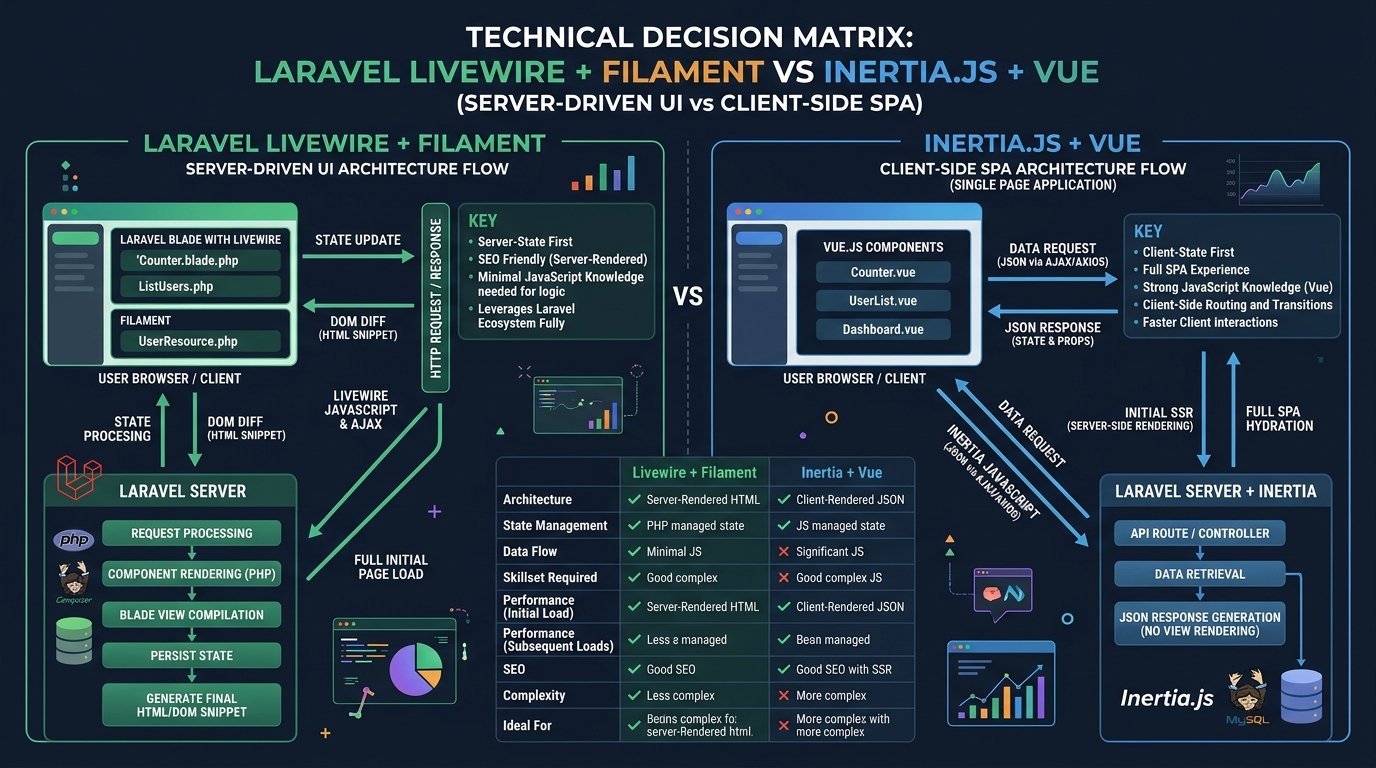
Livewire & Filament vs. Inertia.js (Vue) — An Engineering Decision Matrix
The modern Laravel ecosystem gives full stack engineers two powerhouse approaches to building interactive interfaces without maintaining a separate REST/GraphQL API layer: Server-Driven UI (Livewire + Filament) and Client-Driven SPA (Inertia.js + Vue/React).
Choosing between them shouldn't be ideological. It comes down to state ownership, UI complexity, and team topology.
Architecture Comparison
| Dimension | Livewire + Filament | Inertia.js + Vue |
| Where State Lives | Server (PHP Component properties) | Client (Vue reactive refs / Pinia) |
| Network Traffic | Component state diffs over AJAX | Initial page + JSON page props |
| CRUD & Admin Velocity | Unmatched (schemas in pure PHP) | Moderate (requires Vue templates + forms) |
| Offline / Optimistic UI | Limited (requires round-trip for most actions) | Native (instant client-side transitions) |
| Client-Heavy Widgets | Requires Alpine.js escape hatches | Native (canvas, drag-and-drop, rich editors) |
When Livewire + Filament Wins
If you are building data-dense B2B dashboards, internal operations tools, or multi-tenant SaaS admin panels, Filament + Livewire delivers unmatched velocity.
Form validation, authorization policies, table filters, and bulk actions live in a single PHP class.
Zero context-switching between TypeScript interfaces and PHP DTOs.
Your backend engineers can ship polished, accessible UIs without a dedicated frontend bottleneck.
When Inertia.js + Vue Wins
Once your interface demands sub-50ms client interactions—such as interactive Kanban boards, real-time collaborative editors, complex multi-step configurators, or heavy client-side filtering—network round-trips per keystroke or toggle become noticeable.
Inertia gives you full Vue 3 reactivity while keeping Laravel routing, controllers, and middleware intact.
You avoid building OAuth/Sanctum token handshakes and API versioning just to talk to your own frontend.
The Hybrid Sweet Spot
Many high-performing Laravel teams don't pick just one: they run Filament for the administrative and back-office control plane (/admin) while serving the customer-facing product workspace via Inertia + Vue (/app) inside the exact same repository and domain layer.
Recent Posts

.jpg)
.jpg)
.jpg)